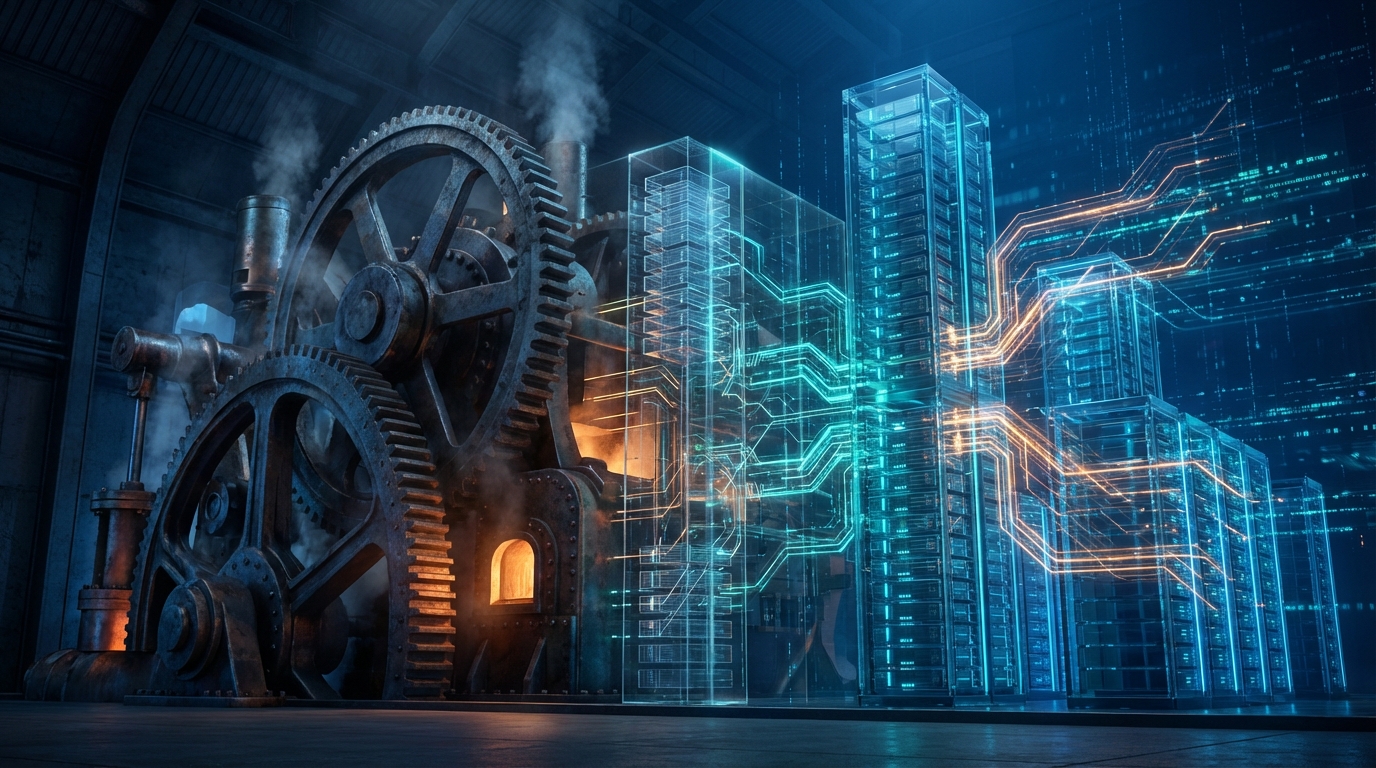
Imagine standing at the edge of the 19th century, watching the first railway tracks cut through the landscape. You weren’t just looking at steel and wood; you were witnessing the death of an old economy and the birth of a superpower. According to a landmark White House paper released this January, we are standing at that exact precipice again.
The paper, titled “Artificial Intelligence and the Great Divergence,” draws a startling parallel between the Industrial Revolution and our current moment. The message to business leaders is clear: AI is no longer just a tech trend. It is the central nervous system of the future economy.
The New Economic Engine
For years, we’ve looked at economic growth through the lens of consumer spending. That script has flipped. The report highlights that US economic growth is now being driven by capital deployment—specifically, the building of AI infrastructure.
Consider the numbers from early 2025:
- Investment in data processing, buildings, and software surged by 28%.
- AI investment alone lifted the US GDP by 1.3% in just six months.
- AI-related projects now account for roughly a quarter of all US investment.
This isn’t a bubble; it is a foundational shift. Just as the railways laid the groundwork for modern commerce, data centers are laying the physical foundation for the next century of productivity.
From Experiment to Routine
If you have been waiting for the “right time” to fully integrate AI into your operations, the window of early adoption has closed. We are now in the phase of mass utility.
By late 2025, 78% of organizations reported using AI, a massive leap from 55% the previous year. Furthermore, nearly half of all US businesses are now paying for AI subscriptions. The technology has graduated from the R&D lab to the production line. It is no longer a novelty; it is a standard operating procedure.
The “Great Divergence”
Why the title “The Great Divergence”? The White House posits that this technology is creating a widening gap between nations—and by extension, companies.
The US is currently outpacing Europe and China in GDP growth, largely fueled by private AI investment and model development. The report argues that deregulation and aggressive investment incentives (like the “One Big Beautiful Bill Act”) are accelerating this lead. The conclusion is stark: entities that lead in AI adoption will experience growth far above the mean, while laggards risk irrelevance.
The Power Constraint
There is one major bottleneck every founder needs to watch: Energy.
The report notes that AI data centers are incredibly thirsty for power. Projections suggest that by 2028, AI infrastructure could consume up to 12% of domestic electricity. The ability to access reliable energy is becoming a prerequisite for leadership in this space.
The Bottom Line
We are moving toward a world where productivity gains of 20%—or in extreme scenarios, 45% GDP growth—are on the table. The “Great Divergence” isn’t just about geopolitics; it’s a signal to the private sector. The infrastructure is being built, the capital is flowing, and the divergence has begun. The only question remaining is which side of the curve your business will sit on.