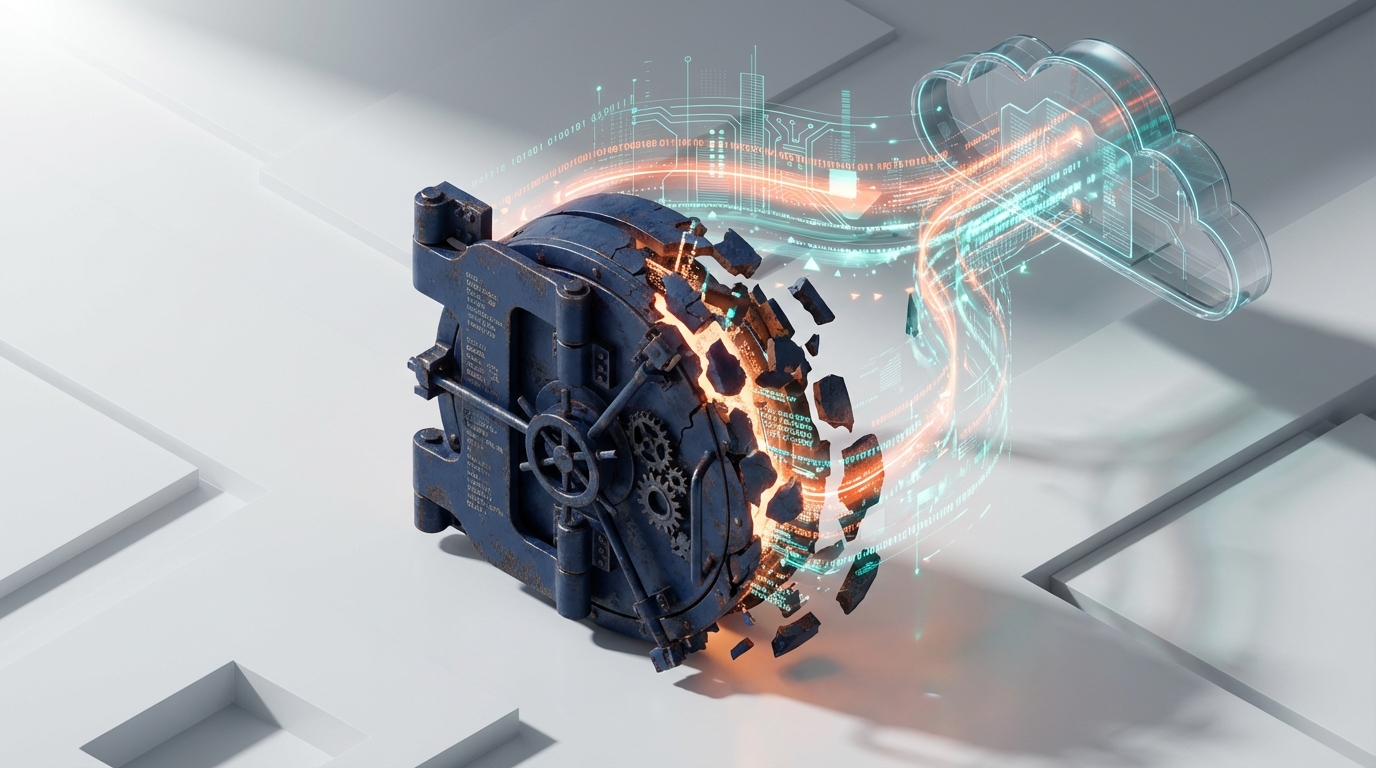
The global financial system runs on a language almost nobody speaks anymore. It is an infrastructure paradox: the most critical transactions—including 95% of all ATM swipes in the US—rely on COBOL, a codebase maintained by a rapidly shrinking workforce.
For decades, modernizing this infrastructure was deemed too risky, too expensive, and too complex. Then, earlier this week, AI startup Anthropic announced that its new tool, Claude Code, could automate the heavy lifting. The market’s reaction was visceral: IBM shares plummeted 13%, marking their worst single-day drop in over 25 years.
The “Consultant” Revenue Model Under Fire
To understand the panic, you have to understand the business model of legacy tech. For years, giants like IBM, Accenture, and Cognizant have generated stable revenue by deploying armies of human consultants to manually map and modernize legacy systems. It is slow, painstaking, and—crucially—billable work.
Anthropic’s pitch strikes directly at the heart of this inefficiency. They claim their AI can automate the exploration and analysis of COBOL—tasks that typically consume years of human effort—and condense them into quarters. Investors looked at that efficiency, did the math on billable hours, and hit the sell button.
Market Reaction vs. Technical Reality
The sell-off was sharp, but was it accurate? Markets often conflate disruption with destruction. While the narrative suggests that AI will erase the need for enterprise consultants, the reality on the ground is far more nuanced.
IBM is not exactly a bystander in this race. They have been deploying their own AI, watsonx Code Assistant, to facilitate exactly this kind of transition. As IBM’s leadership noted during the fallout, translating code is merely the first step. Modernizing the platform—ensuring the security, quantum-safe encryption, and transaction integrity that global banks require—is where the real value lies.
Rob Thomas, IBM’s Senior VP, put it bluntly: “Translating code is one thing. Modernising a platform is something else entirely. The two are not the same.”
The Strategic Takeaway for Founders
Beyond the stock ticker, the signal for business leaders is clear. We are witnessing a shift in how enterprise value is created.
- The Bottleneck is Broken: Projects that have been stuck in the “too hard” or “too expensive” basket for a decade are suddenly economically viable.
- Acceleration, Not Just Replacement: Early adopters like the Royal Bank of Canada are already using AI to map dependencies. They aren’t just cutting costs; they are finally moving at the speed of modern business.
- The Scope is Wider than Mainframes: With 40% of COBOL running on distributed systems like Windows and Linux, this is an industry-wide software architecture shift, not just a hardware problem.
The drop in share price reflects a fear of the unknown. But for the industry, this is simply the friction of evolution. The tools to fix the financial world’s oldest problem have finally arrived—now the real work begins.